Shopify Just Dropped Native llms.txt Support - Let's take a look at what this means;
Quietly, and without much noise, Shopify has started rolling out native llms.txt files for stores. And honestly? We think this is one of the clearest signs yet of where ecommerce search is heading.
If you’ve not come across llms.txt yet, don’t worry - most brands haven’t. But over the next couple of years, files like this are likely to become a normal part of how stores are discovered by AI tools like ChatGPT, Perplexity, Claude and Google AI search.
And Shopify moving first here matters.
So… What Actually Is llms.txt?
Think of it like a sitemap for AI.
Not for Google crawlers. Not for SEO in the traditional sense. Specifically for large language models (LLMs) and AI systems trying to understand your website.
It’s a simple text file that lives at:
yourstore.com/llms.txt
Inside it, you can give AI systems a cleaner, more structured understanding of:
-
what your brand does
-
what products you sell
-
who your customers are
-
and which pages actually matter
Instead of AI trying to piece your business together from bloated HTML, menus, scripts and outdated pages, you’re effectively giving it a shortcut.
Why Shopify Adding This Is Such a Big Signal
This isn’t really about a text file.
It’s about Shopify acknowledging that:
👉 AI discovery is becoming a real ecommerce channel.
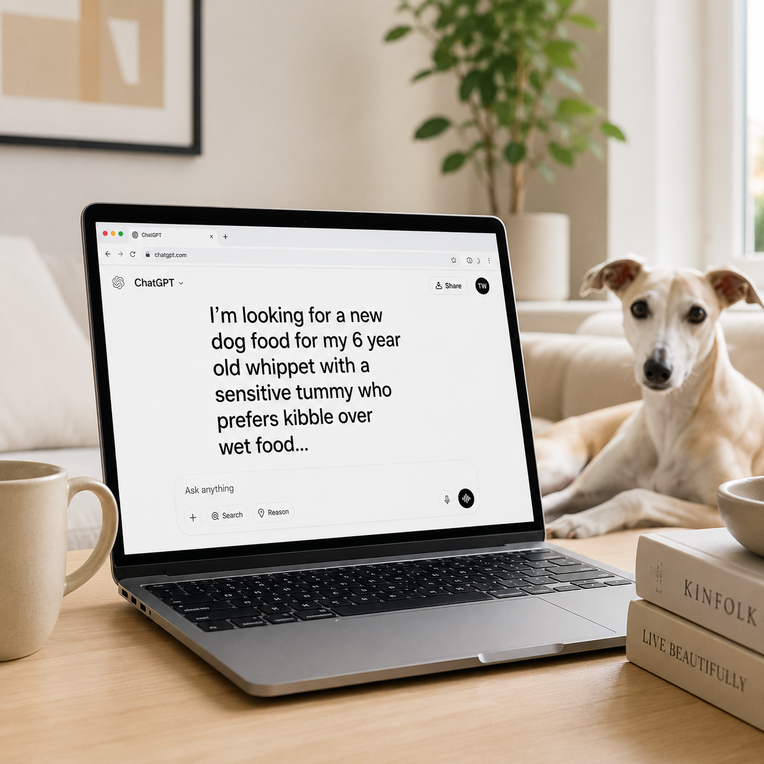
People are already asking tools like ChatGPT things like:
-
“What’s the best protein powder for runners?”
-
“Best olive oil under £20”
-
“Recommend a luxury candle brand”
And increasingly, AI tools are becoming the layer between the customer and the website.
That changes everything.
Because if AI can’t properly understand your store, it’s far less likely to recommend it.
Shopify Is Moving Fast Here
What’s interesting is how quickly Shopify seems to be leaning into this space.
Over the last year we’ve seen:
-
AI-powered shopping experiments
-
native testing tools like Rollouts
-
more structured data support
-
and now native llms.txt support appearing on stores
Compared to a lot of ecommerce platforms, Shopify feels significantly ahead when it comes to preparing merchants for AI-driven commerce.
This is becoming one of the biggest reasons brands are looking seriously at Shopify.
What Should Brands Actually Put In Their llms.txt?
The good news is: it doesn’t need to be complicated. Even better news - Shopify are doing this all for us!
A solid llms.txt usually includes:
-
a short description of your brand
-
key collections or product categories
-
important pages (shipping, returns, FAQ, about)
-
links to useful content or guides
-
context about your customer or positioning
The key is clarity.
Not marketing fluff. Not keyword stuffing. Just accurate, structured information that helps AI systems understand your business properly.
But Here’s The Important Part…
llms.txt is not a magic SEO hack.
And this is where a lot of people are getting carried away.
Even the Shopify community discussions around it are pretty balanced:
-
some AI crawlers appear to read it
-
others are inconsistent
-
and great content still matters far more
If your product pages are weak, your content is vague, or your site structure is messy, an llms.txt file won’t suddenly fix visibility.
What it does do is remove friction.
It helps AI systems understand your brand faster and more accurately.
Our Take
This feels a lot like the early days of technical SEO.
At first, things like sitemaps, schema and metadata felt niche. Then suddenly they became standard practice.
We think llms.txt is heading the same way.
Right now, it’s an early signal. An experiment. But it’s also a pretty clear indication of where ecommerce discovery is going next - and Shopify clearly sees that too.
The brands that win in AI search won’t just be the ones with an llms.txt file. They’ll be the ones with:
-
clear content
-
structured information
-
strong entity signals
-
useful FAQs
-
fast, well-built websites
-
and a platform that’s evolving quickly enough to support all of it
Which is exactly why this Shopify update matters.
Final Thoughts
AI search is changing how customers discover brands. Quietly at first - then all at once.
Shopify dropping native llms.txt support might seem small, but it’s another sign that ecommerce platforms are starting to optimise not just for Google, but for AI recommendation engines too.
Shopify Summer Editions 2026 is going to be HUGE.